
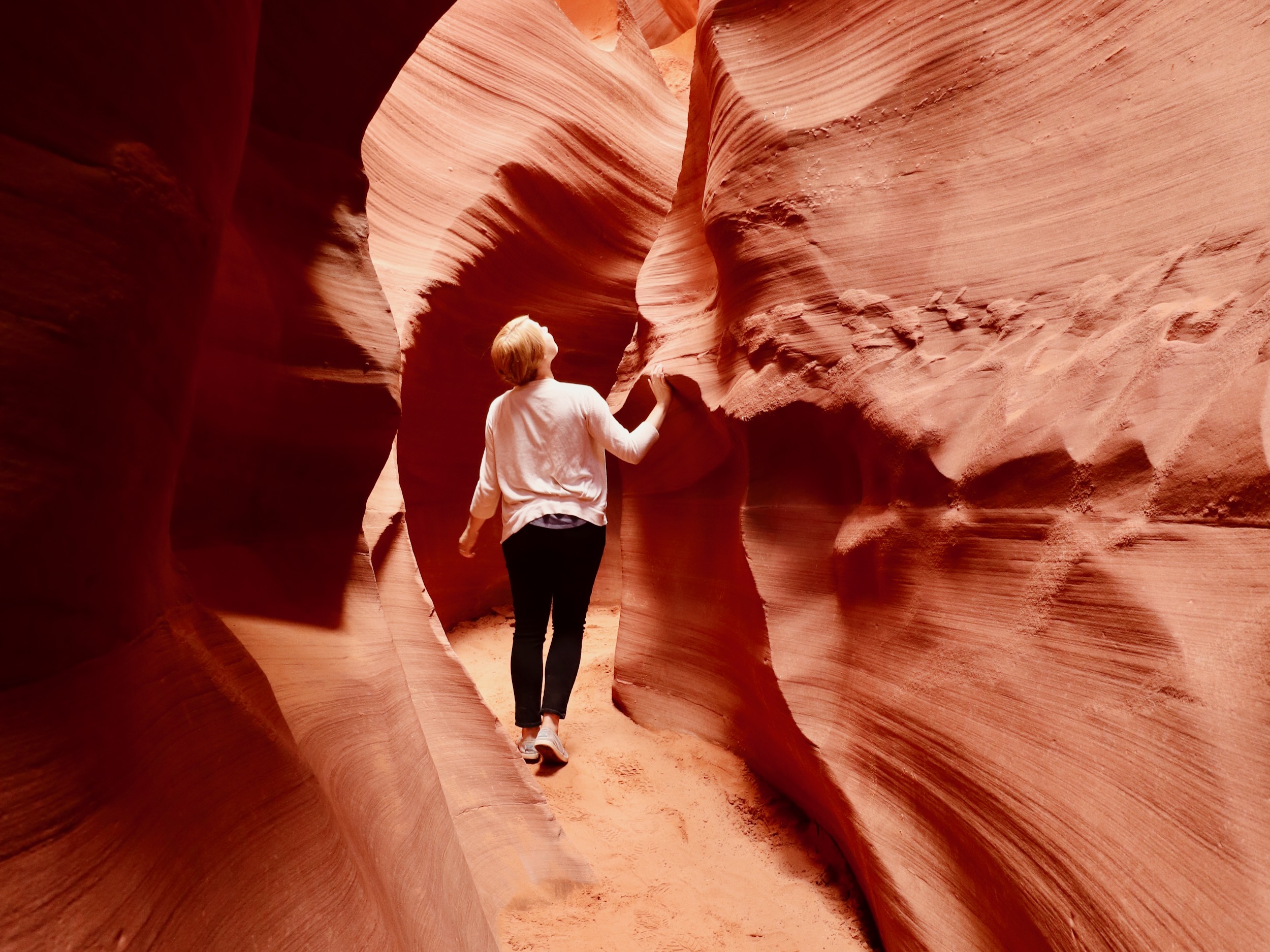
Waiting at the top of a metal ladder leading down into Lower Antelope Canyon, I started wondering whether I’d made a terrible mistake.
I’d been looking forward to visiting Antelope Canyon on my American Southwest road trip in 2017. I’d seen photos of its smooth, burnt-orange walls twisting around narrow passages, and I was excited to finally see this famous Arizona slot canyon for myself.
What I hadn’t really considered was just how narrow those passages would feel once I was actually inside them. I do not handle small, enclosed spaces very well (I’d call it mild claustrophobia), so as I waited in line to descend into the canyon, I could feel my nerves kicking in.
I did manage to make it inside and all the way through the canyon to the other end, where I gratefully stepped back out into the open air. My experience wasn’t entirely what I’d expected, but I’m still glad I did it. Antelope Canyon is really unique, and there are no other places I’ve visited that look quite like it.
If you’re thinking about going, there are a few things worth knowing beforehand — especially when it comes to booking a tour. Here’s my guide to how to visit Antelope Canyon, based on my experience touring Lower Antelope Canyon and updated with current information for planning your own visit.
Quick summary:
Antelope Canyon can only be visited on a guided tour, which should be booked in advance. I visited Lower Antelope Canyon and found its winding sandstone walls spectacular, though the narrow passages and crowding inside presented some challenges. Here’s what I’d recommend knowing before you go.
Recommended tours:
📸 Upper Antelope Canyon Ticket – Explore the famous canyon known for its dramatic light beams.
🏜️ Lower Antelope Canyon Ticket – Descend into the winding slot canyon that I personally visited.
☀️ Antelope Canyon X Ticket – Discover a lesser-visited canyon with striking sandstone formations.

What is Antelope Canyon?
Antelope Canyon is a series of narrow slot canyons located just outside Page in northern Arizona, on Navajo Nation land. The canyons were formed over millions of years as rushing water gradually eroded the sandstone, creating the smooth, curving walls that make this place so distinctive.
There are three main sections that travellers can visit: Upper Antelope Canyon, Lower Antelope Canyon and Antelope Canyon X. Upper is the most famous and is particularly known for the shafts of sunlight that can illuminate the canyon at certain times of year, while Lower involves navigating a more winding passage with metal stairs and ladders. Antelope Canyon X is a less-frequented alternative.
I only visited Lower Antelope Canyon, so that’s the experience I’ll be talking about throughout this guide. I haven’t personally visited Upper Antelope Canyon or Antelope Canyon X, though I’ve included tour options for all three above so that you can choose whichever experience appeals best to you.

Do you need a tour to visit Antelope Canyon?
Yes. You can’t visit Antelope Canyon independently — access is only permitted on a guided tour with an authorised Navajo tour operator.
This isn’t just a way of managing visitor numbers. Antelope Canyon is culturally significant to the Navajo people, its sandstone walls are fragile, and there is also a serious risk of flash flooding when heavy rain hits the area.
You’ll need to make a reservation before arriving, and I’d recommend booking well ahead if Antelope Canyon is a priority for your trip. Tours can sell out weeks in advance, particularly during the busy March–October period and for popular mid-morning time slots.
Your Navajo Nation permit is generally arranged as part of the tour booking process, though exactly what’s included can vary between tours, so check the details when making your reservation.
Booking an Antelope Canyon tour
There are guided tours available for the three main sections of Antelope Canyon — Upper Antelope Canyon, Lower Antelope Canyon and Antelope Canyon X. Which one you choose will depend on the type of experience you’re looking for.
Upper Antelope Canyon
📸 Upper Antelope Canyon is the most famous section and is particularly known for the dramatic shafts of sunlight that can illuminate the sandstone walls at certain times of year. It’s also at ground level, making it a more accessible option than Lower Antelope Canyon.
Lower Antelope Canyon
🏜️ Lower Antelope Canyon is the section that I visited. It’s a little more adventurous, with metal stairs and ladders leading through winding, narrow passages. When I visited in 2017, I booked the general guided tour with Ken’s Tours (one of only two authorised operators) a few weeks in advance.
Antelope Canyon X
☀️ Antelope Canyon X is a less-frequented alternative to Upper and Lower Antelope Canyon. It’s worth considering if you’d prefer to explore one of the area’s spectacular slot canyons without choosing the two most famous sections.
Whichever canyon you choose, I’d recommend booking well ahead if Antelope Canyon is a priority for your trip. Tours can sell out weeks in advance, particularly during the busy March–October period and for popular mid-morning time slots.
The details of my Lower Antelope Canyon tour have changed somewhat since my 2017 visit, so don’t rely on my old booking arrangements when planning your trip. Ken’s current General Tour is a guided walk lasting around 50–60 minutes, with a Navajo guide who takes you through the canyon while sharing information about its geology, history and cultural significance.
Ken’s currently runs tours every half hour between 7 AM and 5 PM. Mid-morning appears to be particularly popular, and some of these time slots can book out weeks in advance.
I’d also allow extra time around the advertised tour duration. You’ll need to arrive early enough to check in, and the 50–60 minute duration refers to the guided walk itself rather than necessarily the entire experience from arrival to departure.

My experience visiting Lower Antelope Canyon
I did a Lower Antelope Canyon tour with my husband in September 2017. We’d been instructed to check in 30 minutes before our 10:20 AM tour, and after arriving at Ken’s Tours, we eventually joined the line to descend into the canyon.
This was the moment when I started getting nervous.
Access to Lower Antelope Canyon involves descending metal stairs into the narrow opening below. I have some mild claustrophobia, and standing there waiting for my turn to climb down into that confined space was a little nerve-wracking.
Once I got inside, the canyon immediately felt busy. There weren’t necessarily a crazy number of people around, but the limited space makes even a relatively small group feel much larger.
The first few chambers felt especially crowded. Everyone has just entered this spectacular place and understandably wants to start taking photos, so most of the people inside were standing around with their phones and cameras in the air.

If you’re visiting, my advice is don’t get too caught up trying to photograph everything immediately. Those first few spots are far from your only opportunity to get beautiful photos. There are plenty of interesting formations and angles further along, and you’ll come across places where there’s less of a bottleneck.
As we continued through Lower Antelope Canyon, the passage changed constantly. In some areas the walls opened up and gave us a little more room; in others they narrowed considerably. There were some ladders and stairs to navigate along the way.
I remember thinking that the canyon was undeniably beautiful. The burnt-orange sandstone twisted into all sorts of curvy shapes, with the light bringing out different shades of orange and red as we moved through. The floor was dusty and covered with fine orange sand.
For me, the tightest sections were challenging. Lower Antelope Canyon is essentially a one-way journey, with very little opportunity to go anywhere other than forwards. Whenever we reached a bottleneck and had to wait our turn to climb a ladder or move through a particularly narrow passage, I could feel my claustrophobia getting the better of me.
At times, I remember feeling like I wanted to move through the canyon faster just so that I could get out sooner.
My husband had a completely different reaction. He thought it felt somewhat crowded, but he wasn’t panicky about the confined space in the way that I was. If small spaces don’t bother you, there’s a good chance you’ll have no issue at all.
It’s something I’d want to know beforehand, though. Those dreamy photos of Antelope Canyon can make it look like an incredibly peaceful place where you’ll be wandering alone between glowing sandstone walls. The reality is that you’re moving through a very narrow environment with other visitors, stopping at bottlenecks and negotiating limited space while everyone tries to get their photos.

Tips for taking photos inside Antelope Canyon
Antelope Canyon is incredibly photogenic, but getting the photos you’ve imagined can require some patience.
Because the canyon is so narrow, you and practically everyone else on your tour will be trying to photograph the same formations from similar positions. Blocking the passage for an extended photoshoot isn’t really practical, and it can become frustrating when everyone has to wait for someone to move.
My biggest tip is to keep going if a particular spot feels too crowded.
There are loads of beautiful locations throughout Lower Antelope Canyon. Instead of battling everyone for exactly the same shot near the beginning, continue through and look for another angle further along. You’ll have plenty of other opportunities.
Current restrictions also affect what photography equipment you can use. Tripods and selfie sticks aren’t permitted, and Ken’s Tours states that professional camera equipment and similar gear aren’t allowed on its tours, so plan on taking handheld photos with your phone or permitted camera.
I’d also keep your equipment protected from the fine sand as much as possible. It gets everywhere inside the canyon, and changing camera lenses in that environment isn’t a great idea.

Best time to visit Antelope Canyon
Antelope Canyon can be visited year-round, but the experience varies depending on when you go.
The famous shafts of sunlight that you may have seen in photos of Upper Antelope Canyon generally occur around the middle of the day between spring and autumn, which makes these times particularly popular. March through October is the busier period overall, with mid-day tours attracting visitors hoping to see the best lighting conditions.
If I visited Antelope Canyon again, I’d personally be tempted to choose one of the first tours of the morning — or potentially one of the final tours of the afternoon.
I can’t guarantee that these tours will be quieter, but after my experience, I’d happily sacrifice the most sought-after lighting conditions for the possibility of having fewer people around. Lower Antelope Canyon tours can start as early as 7 AM, so I’d probably take the early start and give that first time slot a try.
If getting the classic Antelope Canyon photos is your main priority, however, your ideal timing may be completely different.

Is Antelope Canyon worth visiting?
I left with mixed feelings about my experience at Lower Antelope Canyon.
I didn’t particularly love being inside the slot canyon, but I’ll absolutely admit that this natural attraction is undeniably beautiful. It was just that the narrow passages and bottlenecks made it difficult for me to relax and properly enjoy where I was. My claustrophobia got the better of me.
My husband didn’t have the same problem. He noticed the crowds, but the confined environment didn’t make him anxious, which is why I wouldn’t assume my experience will be the same for everyone.
If you’re comfortable in small spaces, I think you’ll have a much easier time appreciating Lower Antelope Canyon for what it is. The sandstone formations are extraordinary, and seeing those swirling orange walls in person is completely different from seeing them in photographs.
Despite my discomfort, I’m still glad I visited. Antelope Canyon was a memorable destination and is definitely worth including on an American Southwest road trip.
I’d just go into it with realistic expectations. Antelope Canyon can be busy, Lower Antelope Canyon has some very confined spaces, and getting those seemingly effortless photos may require patience. It pays to know those things before you go.

Antelope Canyon FAQ
What should you wear to Antelope Canyon?
Wear comfortable, closed-toe shoes with good grip. Antelope Canyon has a sandy, uneven floor as well as metal stairs and ladders. I’d also wear layers, as the canyon interior can feel cool.
What can you bring into Antelope Canyon?
Bring water, sunscreen, sunglasses and a hat for the time spent outside. Bags, backpacks, tripods and selfie sticks may be prohibited inside the canyon, so check your tour operator’s current restrictions before arriving.
Does Antelope Canyon close when it rains?
It can. Flash flooding is a serious risk in slot canyons, so tours may be cancelled when weather conditions make entering Antelope Canyon unsafe. Heavy rain and storms can happen during Arizona’s summer monsoon season (June through September). If the forecast looks questionable, check with your tour operator before travelling to the canyon.
Can you visit Antelope Canyon and Horseshoe Bend on the same day?
Yes. Antelope Canyon and Horseshoe Bend are both located near Page, Arizona, so it’s easy to combine them in the same day. I’d schedule your Antelope Canyon tour first because you’ll have a fixed reservation time, then plan your Horseshoe Bend visit around it.
What time zone does Antelope Canyon use?
Antelope Canyon tours operate on Page, Arizona time (Mountain Standard Time). Be careful when arriving from nearby Utah, which observes daylight saving time and may be an hour ahead during summer. Phones can connect to towers in Utah or the surrounding Navajo Nation and display the wrong time. Check the current time in Page rather than relying solely on your phone.
Leave a Reply