
This post was originally published on A Globe Well Travelled in 2016. The content has been revised and updated with fresh information.
When my husband came home from a recent solo trip to Montreal describing it as “basically Brooklyn but vaguely European”, I knew exactly what he meant.
It had been a while since our own trip to Montreal, but hearing about him hiking up Mount Royal, wandering through pedestrianised neighbourhood streets and generally enjoying the city all over again reminded me why we liked it so much in the first place.
My first visit was actually a surprise birthday trip I’d planned for my husband from New York — although the surprise didn’t last particularly long once I told him to bring his passport. We spent our time wandering the cobblestone streets of Old Montreal, exploring neighbourhoods like Le Plateau and Mile End, cycling along the canal and eating our way through some of the city’s most famous foods.
My husband’s latest trip covered some familiar ground, but he also discovered a few things we hadn’t experienced together, including the Montreal Botanical Garden and some of the more substantial hiking trails around Mount Royal. So it seemed like the perfect excuse to revisit this guide and give it a much-needed update.
If you’re visiting for the first time, these are the best things to do in Montreal, combining the places we loved on our original trip with a few fresh recommendations.
Quick summary:
Planning your first trip to Montreal? This guide covers the best things to do in Montreal, from exploring Old Montreal and Mount Royal to food spots, markets and local experiences, with personal tips from our visits to the city.
Recommended tours:
👣 Old Montreal Walking Tour – Small-group guided walk covering history, culture, food and hidden local spots
🚲 Bike Tour of Montreal’s Hidden Treasures – 3-hr ride through neighbourhoods, parks and Old Port highlights
🚢 Montreal Sightseeing River Cruise – See major city landmarks on a relaxing 90-minute St Lawrence cruise
🥯 Montreal Bagel Making Workshop – Hands-on class learning traditional techniques in a Mile End apartment
Best things to do in Montreal


Explore Old Montreal (Place d’Armes, Rue Saint Paul & Place Jacques Cartier)
We started our city exploring in Old Montreal, and it’s easily the best place to get your bearings in the city. This area feels completely different from the rest of Montreal — more like a slice of Europe, with cobblestone streets, historic buildings and grand public squares.
👣 Old Montreal is fairly compact, so you can easily explore it on foot. If you want a bit more context, a small-group Old Montreal Walking Tour can be a good way to get your bearings, with a local guide sharing insights into the architecture, culture and food scene along the way.
One of the main focal points in Old Montreal is Place d’Armes, where the grand Notre-Dame Basilica of Montreal overlooks the square and adds to the European feel of the area.
From Place d’Armes, it’s an easy walk over to Rue Saint Paul — a cobblestone street lined with boutiques, galleries and souvenir shops. It’s definitely one of the more touristy parts of Montreal, but still worth a wander just to take in the atmosphere and architecture.
If you keep walking, you’ll eventually reach Place Jacques Cartier, a lively square filled with restaurants, street performers and market stalls. It’s a good spot to pause for a drink or just soak up the energy before continuing your exploring.
We also spotted the rooftop bar at the nearby Hotel Place d’Armes and decided to head up for a drink. Sitting under the red umbrellas with a (slightly overpriced but excellent) mojito and looking out over the square was a pretty great way to ease into the trip.

Visit Notre-Dame Basilica of Montreal
Sitting right on Place d’Armes, Notre-Dame Basilica of Montreal is one of the most recognisable landmarks in the city — and one of the most popular places to visit.
We actually didn’t go inside on our visit. The line was fairly long when we arrived, and after spending a lot of time travelling through Europe (and visiting what felt like hundreds of churches), we decided to give it a miss and keep exploring.
That said, if it’s your first time in Montreal (or you haven’t already hit your limit on cathedrals) this is one of the few that’s genuinely considered worth prioritising. The interior is known for its deep blue ceiling, intricate woodwork and dramatic lighting, which makes it feel quite different from the more traditional European churches.
If you’re planning to go inside, it’s worth arriving early or booking a timed entry ticket in advance to avoid waiting around in line, especially during peak travel seasons. Even if you decide not to go in, it’s still worth stopping by Place d’Armes to see the exterior.

Head up to Mount Royal (Chalet views)
It took both of us an embarrassingly long time to realise that Mount Royal is actually the namesake of Montreal (cue facepalm).
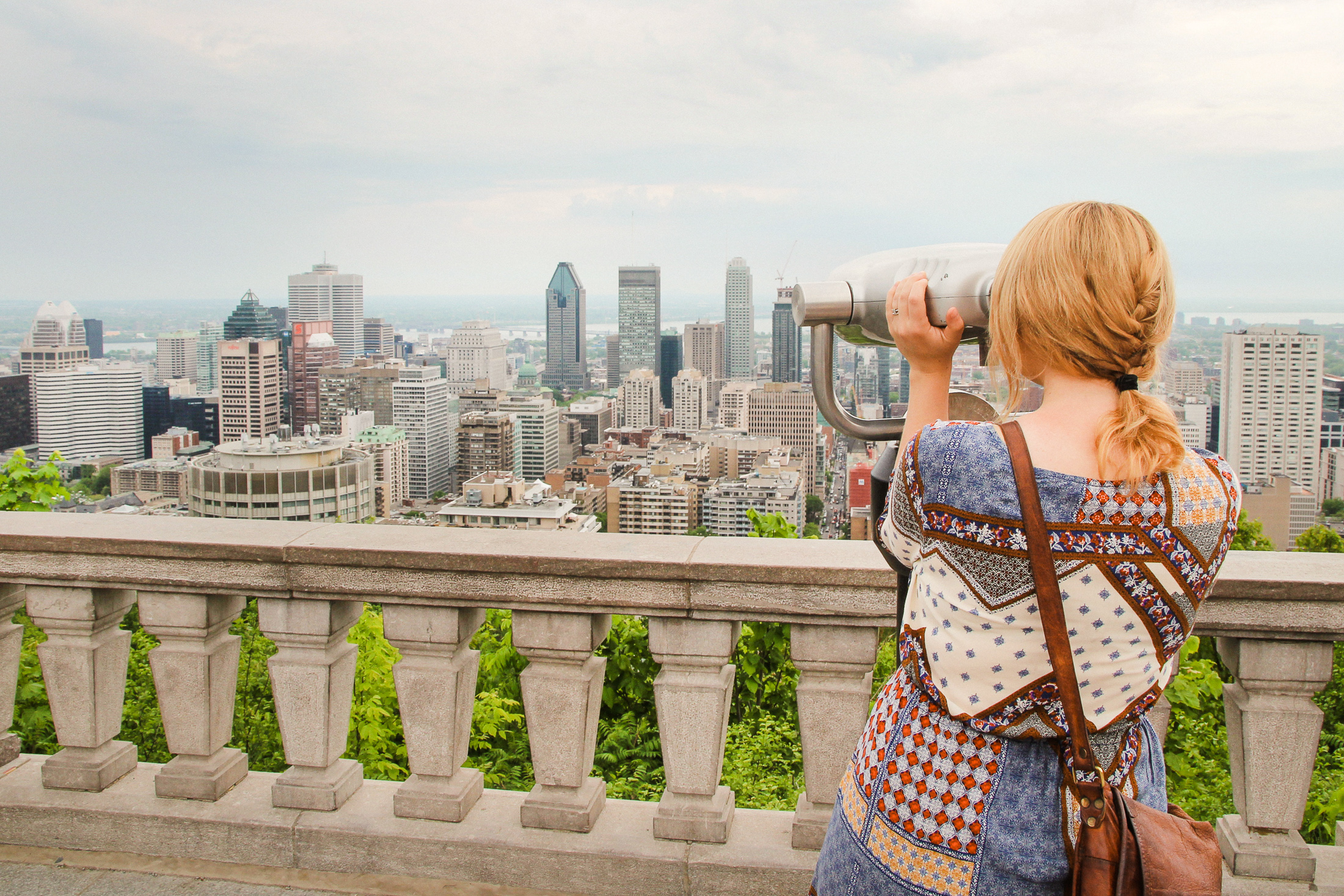
If you’re visiting the city for the first time, this is easily one of the best things to do. Mount Royal sits just outside the downtown area and offers one of the most iconic views over the skyline.
On our original trip, we walked up via the path from the north end of Rue Peel, which took around 15–20 minutes at a steady pace. It’s not a particularly difficult climb, but it’s just enough to get your heart rate up — especially in warmer weather.
My husband took a different route on his recent trip and quickly discovered that Mount Royal can be much more of a hike than we remembered. He followed a wooded trail through the park, complete with rocky and uneven sections. So if you’re heading up on foot, keep in mind that the difficulty can vary quite a bit depending on the route you choose.
At the top, you’ll reach the Kondiaronk Belvedere near the Chalet du Mont Royal, where you get a wide, open view across the city and out toward the St Lawrence River. It’s one of those viewpoints that really gives you a sense of how Montreal is laid out, and it’s well worth the effort to get there.
🚲 If you’d rather not hike up the mountain, a guided bike tour is another option. This Montreal Hidden Treasures Bike Tour takes you through several neighbourhoods and green spaces, including Mount Royal and La Fontaine Park, before continuing through the Old Port. You can also opt to keep your bike afterwards if you want to continue exploring independently.

Join the Tam Tams on Mount Royal (Sundays only)
If you happen to be in Montreal on a Sunday, one of the more unique things you can experience is the Tam Tams.
Held at the base of Mount Royal near the Monument à Sir George-Étienne Cartier, Tam Tams is essentially a weekly gathering where people show up with drums and instruments and play together in an open, free-form jam session.
Despite the name, it has absolutely nothing to do with Tim Tams (the chocolate biscuits back home in Australia — unfortunately). Instead, it’s a mix of music, dancing and a very laid-back, slightly chaotic atmosphere that feels more like a casual festival than an organised event.
There’s no real schedule or structure — people just turn up, sit on the grass, join in if they want to, or just watch from the sidelines. Some are clearly talented musicians, others are just there for the fun of it, and that’s kind of the whole appeal.
We spent about an hour here just soaking up the vibe, and it ended up being one of the more memorable parts of the weekend. It’s not something you’d go out of your way to plan a trip around, but if your timing lines up, it’s definitely worth checking out.

Explore Le Plateau Mont Royal neighbourhood
Just north-east of Mount Royal, you’ll find Le Plateau Mont-Royal — one of the most character-filled neighbourhoods in the city.
This was easily one of my favourite areas to wander. The streets are lined with colourful houses, many with those iconic winding outdoor staircases that Montreal is known for. It feels a lot more local than Old Montreal, with fewer tourists and more of a lived-in, residential vibe.
It’s the kind of place where you don’t really need a plan — just walking around and seeing what you come across is half the experience. There are plenty of small cafés, independent boutiques and quiet side streets that make it a great spot to slow things down after the busier parts of the city.
When my husband visited recently, one of the things he kept messaging me about was how many streets had been closed to traffic and turned into pedestrian spaces for the warmer months. There were outdoor terraces, benches, plants and flowers everywhere, and he was particularly impressed by how much space had been given back to people rather than cars. It made the neighbourhood even nicer for aimless wandering — which is basically the best way to experience the Plateau anyway.
While you’re in the area, it’s worth stopping by Juliette & Chocolat — just keep in mind that this isn’t your average chocolate shop. It’s more like a dessert restaurant, serving up rich, over-the-top dishes loaded with chocolate, caramel and house-made sauces. We ended up sharing something here, which was definitely the right call — the portions are no joke.

Eat and drink in Mile End & visit Jean-Talon Market
If you keep walking north-east from Le Plateau, you’ll eventually make your way into Mile End — a neighbourhood known for its creative, slightly hipster vibe and, more importantly, its food scene.
This is a great area to explore if you’re into cafés, bakeries and casual places to eat. There’s no shortage of options, and it’s the kind of neighbourhood where you can easily spend a few hours just wandering between spots and trying whatever catches your eye.
One of the standout places nearby is Jean-Talon Market, which is one of the largest public markets in the city. This is where locals come to shop for fresh produce, and it has a much more authentic feel compared to the more tourist-focused areas.
When we visited, the smell of fresh strawberries was almost impossible to ignore — which probably explains why the line at the juice stall was so long. It’s a great place to pick up snacks, grab something quick to eat, or just wander through and take it all in.

Explore the Montreal Botanical Garden
The Montreal Botanical Garden wasn’t somewhere we made it to on our original trip, but my husband visited recently and really enjoyed wandering around the gardens.
It’s a completely different experience from exploring Montreal’s neighbourhoods, with sprawling green spaces, themed gardens and quiet paths to wander. From the photos my husband sent me, it looked incredibly lush, with plenty of wildlife along the way too.
My husband spent a few hours exploring, so I’d allow a decent chunk of time rather than trying to squeeze it between other attractions. There’s also a vegetarian café inside the gardens, which is a handy option if you’re planning to stay for lunch.
I wouldn’t prioritise the Botanical Garden over Old Montreal or Mount Royal on a first visit, but if you enjoy green spaces and have the time, it’s a lovely addition — and one I’ll be adding to my own list for next time.


Explore Montreal’s Old Port
The Old Port is one of those areas you’ll probably end up in at some point while exploring Montreal, with waterfront paths, historic buildings and plenty going on along the St Lawrence River.
We actually arrived here by bike. One thing we noticed pretty quickly in Montreal is how bike-friendly the city is, so we hired bikes and headed down towards the Lachine Canal. The mostly flat path follows the water towards the Old Port, making it an easy and scenic way to reach the area.
We started near Rue Richmond and followed the canal towards the waterfront, passing parks and plenty of locals out walking, running and cycling. By the time we reached the Old Port, we were just in time to catch a random marching band playing a surprisingly good rendition of the Ghostbusters theme — one of those completely unplanned travel moments that sticks with you.
Unfortunately, our cycling adventure was cut short by a sudden downpour, but there’s plenty to explore around the Old Port itself if the weather is behaving. You can wander along the waterfront, continue exploring on foot, or just find somewhere to stop and take in the views across the river.
🚢 Once you reach the Old Port, you could swap two wheels for the water and join the Montréal Sightseeing River Cruise from the Grand Quay pier. The 90-minute cruise travels along the St Lawrence River past landmarks including the Biosphere, Jacques Cartier Bridge and Olympic Stadium.

Eat some Poutine
You can’t visit Montreal without trying poutine at least once. If you’re not familiar with it, poutine is a dish made up of fries topped with cheese curds and gravy — which, on paper, doesn’t sound particularly appealing. In reality, it’s one of those comfort foods that tastes far better than it looks.
As a vegetarian, it took us a little while to find a version we could actually eat, but we eventually ended up at La Belle Province, where they served it with onion and capsicum instead.
We decided to share one between us, which turned out to be a very good decision — the portion size was huge, and it’s a pretty heavy dish. It’s definitely not something you need more than once in a weekend, but it’s one of those local foods that’s worth trying just to say you’ve had it.
You’ll find poutine all over the city, from casual diners to more modern restaurants that put their own spin on it, so there’s plenty of choice depending on how traditional (or adventurous) you want to go.

Get a Montreal Bagel
Another food you’ll hear about pretty quickly in Montreal is the Montreal bagel — and yes, it’s very much its own thing.
Compared to New York bagels, Montreal bagels are smaller, slightly sweeter, and have a much larger hole in the middle. They’re boiled in honey-sweetened water before being baked in a wood-fired oven, which gives them a slightly crisp exterior and a softer, denser texture inside.
You’ll find bagel shops all over the city, but Mile End is particularly well known for them. Places like St-Viateur Bagel and Fairmount Bagel are two of the most famous, and both have been around for decades.
Even if you’re not a huge bagel person, it’s worth trying one while you’re here — especially fresh out of the oven. It’s a quick, inexpensive snack and an easy addition to your itinerary if you’re already exploring the Mile End area.
🥯 If you’re curious about how they’re made, you can take it a step further with a hands-on experience like a Montreal bagel-making workshop. Classes walk you through the full process — from kneading the dough to baking and topping your own bagels.

Visit Montreal’s bars or join a brewery tour
As both my husband and I are fans of craft beer, we can’t visit a new city without trying at least a few of the local brews — and Montreal definitely delivers on that front.
We ended up stopping by a couple of places in Mile End, including Alexandraplatz, where we found some solid German-style beers. Our hostel bar also served a few French-Canadian options, so it was easy enough to sample a mix without going too far out of our way.
🍺 Joining a guided experience like the Montreal Craft Beer Tour can be a great way to get a bit of context around the city’s craft beer culture. Tours like this typically take you through neighbourhoods such as the Latin Quarter, stopping at a handful of brewpubs to sample different beers along the way.
If you’re more into wine or cocktails, there’s plenty of choice across the city as well — especially around Old Montreal and the Plateau, where you’ll find everything from casual bars to more polished spots.

FAQs about visiting Montreal
What is the best time to visit Montreal?
The best time to visit Montreal depends on what you want to do, but the warmer months are ideal for exploring on foot, cycling and enjoying the city’s outdoor spaces. Summer also brings pedestrianised streets, terraces and plenty of activity around the neighbourhoods.
How many days do you need in Montreal?
I’d allow at least two or three days for a first visit to Montreal. That gives you enough time for Old Montreal, Mount Royal and a few neighbourhoods without rushing, while an extra day gives you time for places like the Botanical Garden.
Is Montreal worth visiting?
Definitely. What I like most about Montreal is that it feels quite different from other North American cities, with its French influence, historic architecture, walkable neighbourhoods and excellent food scene. It’s an especially good destination if you enjoy exploring cities on foot.
Do you need a car in Montreal?
No, you don’t need a car to explore Montreal. Many of the areas in this guide are walkable, while the Metro makes it easy to travel further. My husband also used the newer REM on his recent trip and had no trouble getting around without a car.
Where is the best area to stay in Montreal?
For a first visit, I’d stay somewhere central with easy access to the Metro. On our trip, we stayed at Saintlo Montréal Hostel (formerly HI Montreal Hostel) near Lucien-L’Allier station in Downtown Montreal, which was a really convenient base for getting around. Old Montreal is another good option if you want to be close to the historic sights, while Le Plateau is ideal if you’d prefer more of a neighbourhood feel.


Leave a Reply